Keypoints
- TrendAI MDR recovered both server-side tooling and endpoint-side malware, enabling a full view of Banana RAT’s operational chain.
- Banana RAT is attributed to SHADOW-WATER-063 and is focused exclusively on Brazilian financial institutions.
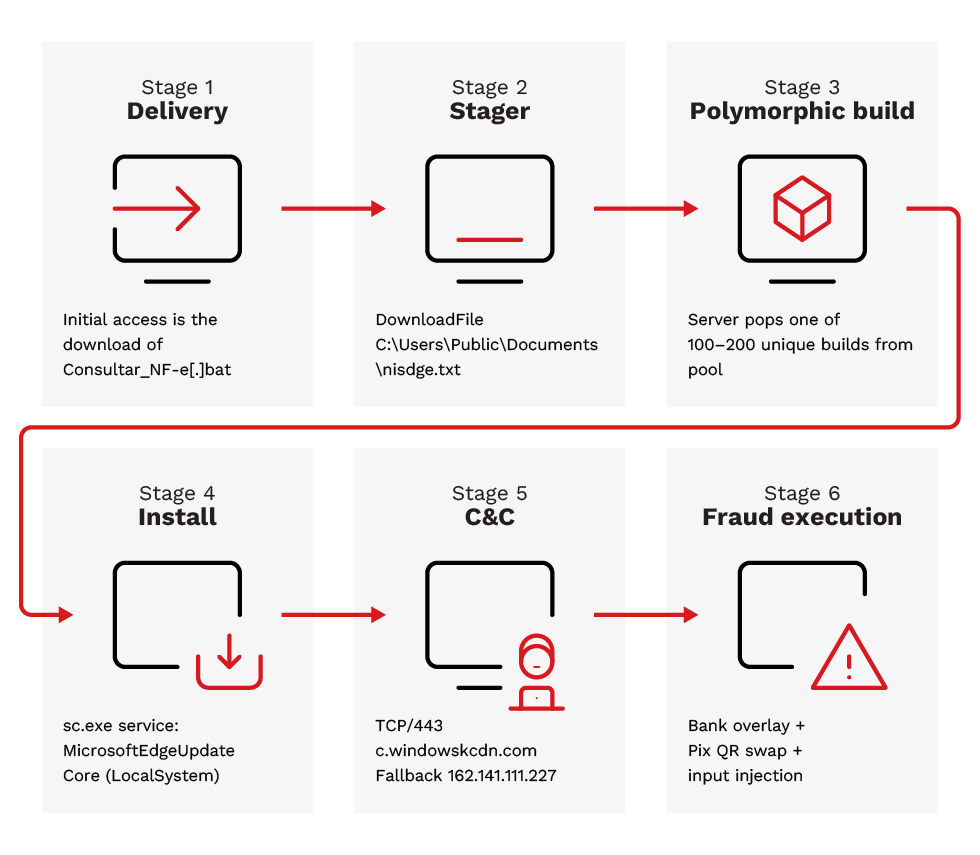
- The delivery chain starts with a malicious batch file,
Consultar_NF-e.bat, downloaded fromconvitemundial2026[.]comand executed via PowerShell. - The operator infrastructure uses a FastAPI-based crypter/polymorphism pipeline to generate unique, layered-obfuscated payloads for each victim request.
- The malware executes largely filelessly in memory, using PowerShell, AES-wrapped payloads, and hidden scheduled-task persistence.
- Banana RAT supports operator-driven fraud through screen streaming, remote input control, keylogging, clipboard manipulation, overlay injection, and file exfiltration.
- The campaign includes a Brazil-only Pix QR interception subsystem and targets bank and crypto pages localized for the Brazilian market.
MITRE Techniques
- [T1059.001 ] PowerShell – Used to fetch, decrypt, and execute staged payloads in memory (‘the batch file launches an obfuscated PowerShell command’; ‘executes the resulting plaintext via ScriptBlock::Create’).
- [T1055 ] Process Injection – The unpacked banker uses in-memory execution and runtime loading patterns to run code without writing decrypted payloads to disk (‘a fileless pattern that prevents the decrypted banker from ever touching disk’).
- [T1027 ] Obfuscated Files or Information – The campaign uses layered obfuscation, polymorphism, junk-code insertion, and AES wrapping to evade detection (‘applies multiple obfuscation layers and an AES-256-CBC wrapper’; ‘Nine in-house obfuscation layers’).
- [T1105 ] Ingress Tool Transfer – The stager downloads the next-stage payload from attacker-controlled infrastructure (‘downloads payload.php from a second attacker-controlled host’).
- [T1053.005 ] Scheduled Task – The malware creates a hidden scheduled task for persistence (‘registered a hidden scheduled task configured to execute powershell.exe’).
- [T1071.001 ] Web Protocols – The operator uses HTTP endpoints for payload staging and campaign infrastructure (‘A single HTTP GET request from the staging cradle to payload.php’; ‘publicly accessible over HTTP’).
- [T1090 ] Proxy – The larger stager uses BITS and WebClient fallback for reliability through proxies (‘uses Start-BitsTransfer with a WebClient fallback for greater reliability through proxies’).
- [T1113 ] Screen Capture – The malware continuously captures the desktop and streams JPEG frames to the operator (‘Continuously captures the desktop … and streams JPEG frames’).
- [T1056.001 ] Keylogging – It records keystrokes in a buffer for later exfiltration (‘captures all keystrokes into a 2,000-entry ring buffer’).
- [T1056.002 ] GUI Input Capture – The malware monitors and manipulates clipboard data and input for fraud (‘Clipboard monitoring’; ‘Remote input control’; ‘Input blocking’).
- [T1204.002 ] Malicious File – User Execution: Malicious File – The victim is tricked into opening a malicious batch file disguised as an invoice document (‘users are tricked into downloading is disguised as an electronic invoice document’).
- [T1112 ] Modify Registry – Not explicitly mentioned; omitted.
- [T1140 ] Deobfuscate/Decode Files or Information – The stager decrypts an AES-wrapped payload in memory before execution (‘decrypts the AES-wrapped body using the embedded key and IV’).
- [T1543.003 ] Create or Modify System Process: Windows Service – SYSTEM token abuse is used to spawn PowerShell in the interactive desktop (‘duplicates SYSTEM token and spawns PowerShell into the user interactive desktop’).
- [T1074.001 ] Local Data Staging – The payload is written to a benign-looking path under a public directory before execution (‘writes it to a world-writable path under a benign filename’).
Indicators of Compromise
- [SHA256] Malware files and stages – ecdc8fade561a75d68235859ad8b1fe131db2c458b4894268e38e90ecab1c47f, 38dfeb772afbd01c04eddda120d283acfb1147a6dc3d54ac62fe23ad06e39d8f, and 2 more hashes.
- [File names] Dropped or executed payloads –
Consultar_NF-e.bat,msedge.txt, and other staged filenames such asst.txtandst.php. - [Domains] Delivery and C&C infrastructure –
convitemundial2026[.]com,c[.]windowsk-cdn[.]com, and other associated domains. - [IP addresses] Attacker infrastructure and fallback C&C –
24.199.90.58,162.141.111.227, and the active service on port 80/443. - [URLs] Payload delivery endpoints –
hxxp[://]24[.]199[.]90[.]58:80/payload[.]php,hxxp[://]24[.]199[.]90[.]58:80/st[.]txt, and related staging URLs. - [Windows paths] Staging and masquerade locations –
C:UsersPublicDocumentsmsedge.txt,C:Users70397AppDataRoamingMicrosoftDiagnosisETWmsedgeupdate.txt, and other ETW-like paths.
Read more: https://www.trendmicro.com/en_us/research/26/e/banana-rat.html