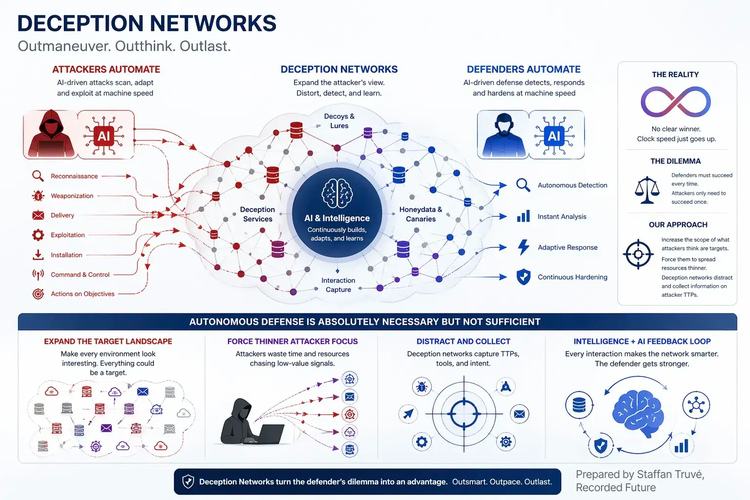
The article argues that combining AI with threat intelligence can transform cybersecurity defense from reactive automation into continuous, context-aware decision-making that maps attacker TTPs against an organization’s real exposure. It also shows how AI-enabled deception, predictive prioritization, and active incident reasoning can narrow the attacker-defender asymmetry and improve outcomes for organizations like Machine Counter Intelligence. #MachineCounterIntelligence #MITREATTACK
Keypoints
- AI is described as most valuable when fused with threat intelligence, not just when used to automate existing security workflows.
- The article emphasizes that defenders gain the most from continuously mapping attacker TTPs against live exposure, patching state, and detection coverage.
- AI can merge external threat intelligence with internal weakness data to produce an integrated view of where adversary capabilities intersect with an environment’s real risks.
- Threat intelligence can drive smarter patch prioritization and detection engineering by focusing on what adversaries are actually using in the wild.
- AI enables continuous attack-path modeling and incident prediction, helping defenders anticipate next steps such as credential targeting, persistence, or exfiltration.
- AI-driven deception can create adaptive honeypots, honeytokens, and decoy infrastructure that misleads attackers and generates new intelligence.
- The article concludes that the strategic divide is shifting toward AI-augmented versus non-augmented defenders, with automation-grade intelligence becoming essential.
MITRE Techniques
- [T1190] Exploit Public-Facing Application – The article notes that AI can map threat reports to whether a vulnerable product is deployed and whether the vulnerability is exploitable in the organization’s environment (‘a particular adversary group is exploiting a vulnerability in a specific product’).
- [T1595] Active Scanning – The article describes assessing exposed attack paths, open network paths, and whether relevant conditions exist for a technique to work (‘Are the relevant network paths open?’).
- [T1018] Remote System Discovery – AI can evaluate the live environment to determine exposed systems and routes that attackers may use (‘cross-reference the described TTPs against a live model of your infrastructure’).
- [T1068] Exploitation for Privilege Escalation – The article discusses patch prioritization and vulnerabilities being exploited in the wild, which can include escalation paths (‘which vulnerabilities are actually being exploited in the wild’).
- [T1003] OS Credential Dumping – During active incidents, AI may predict which credentials attackers are likely to target next (‘which credentials they will target’).
- [T1078] Valid Accounts – The article explicitly mentions synthetic credentials and attackers targeting service accounts in deception environments (‘mimic the type of service account the adversary’s tooling is known to target’).
- [T1021] Remote Services – The discussion of lateral movement patterns and attack-path modeling implies use of remote movement through systems (‘observed initial access technique and lateral movement pattern’).
- [T1040] Network Sniffing – The article references deception and attacker tradecraft broadly, but does not clearly describe sniffing; omitted.
- [T1055] Process Injection – Not explicitly mentioned in the article; omitted.
- [T1041] Exfiltration Over C2 Channel – The article mentions predicting data attackers may exfiltrate (‘which data they are likely to exfiltrate’).
- [T1036] Masquerading – AI-generated deception and plausible decoys can resemble legitimate services, shares, and accounts (‘fake services, plausible file shares, synthetic credentials’).
- [T1201] Password Policy Discovery – The article does not mention this technique; omitted.
- [T1566] Phishing – Not explicitly described in the article; omitted.
- [T1098] Account Manipulation – The text refers to overprivileged accounts as exposure data and to credentials in deception, but does not explicitly state account manipulation; omitted.
- [T1027] Obfuscated Files or Information – The article does not mention obfuscation; omitted.
Indicators of Compromise
- [File names / assets] Deception and exposure examples – fake services, plausible file shares, synthetic credentials, and decoy infrastructure
- [Threat reports / intelligence content] AI analysis inputs – TTP descriptions, known adversary group activity, targeting patterns, tooling, objectives, and detection gaps
- [System / environment data] Defensive context used for prioritization – patching state, segmentation, overprivileged accounts, and detection coverage
- [Time-based query context] Example analysis window – “the last 90 days”
Read more: https://www.recordedfuture.com/blog/ai-intelligence-cyber-defense