
State-sponsored APT activity originating in the Middle East focuses on long-term infiltration and intelligence collection using spear-phishing, malicious documents, and abuse of legitimate RMM tools. Defensive emphasis is placed on endpoint behavior-based EDR to detect post-execution activity and persistent misuse of legitimate administration platforms. #MuddyWater #Atera
Tag: EDR
CharlieKirk Grabber is a Python-based Windows infostealer that performs rapid “smash-and-grab” credential harvesting, system reconnaissance, and immediate exfiltration using legitimate Windows utilities and multithreading to minimize runtime. It stages browser credentials, Discord tokens, Wi‑Fi and game session artifacts, compresses them, uploads the archive to GoFile, and sends the download link via Discord or Telegram for attacker retrieval. #CharlieKirk #GoFile

FortiGuard Labs observed a phishing campaign delivering a new XWorm RAT variant via malicious Excel attachments that exploit CVE-2018-0802 to execute an HTA which runs JScript/PowerShell, loads a fileless .NET module, and deploys XWorm into Msbuild.exe via process hollowing. XWorm v7.2 communicates with AES-encrypted C2 servers (example: berlin101.com:6000), supports a modular plugin architecture and extensive control commands enabling full remote control, data exfiltration, DDoS, and ransomware capabilities. #XWorm #MicrosoftWindows

Security researchers uncovered a mass-distributed macOS loader delivered via cracked music plugin DMGs that deploys multistage payloads including Odyssey and MacSyncStealer and an additional Mach-O loader. The campaign leverages social engineering (including ClickFix-style browser prompts), obfuscated shell scripts, and PPI/affiliate tracking to retrieve and execute secondary payloads from domains such as mac[.]fleebottom-33[.]xyz and robincompany[.]xyz. #MacSyncStealer #Odyssey

Researchers demonstrate a new False File Immutability (FFI) exploit, Redux, that leverages the Windows Cloud Files driver (cldflt.sys) and FltWriteFileEx to modify in-use executables and achieve kernel-level code execution without requiring SMB/network redirectors. The technique bypasses prior mitigations (and remains effective on some patched Windows versions), and proof-of-concept exploits and mitigations (including an Elastic Defend rule and a filesystem minifilter) were released. #FalseFileImmutability #PPLFault
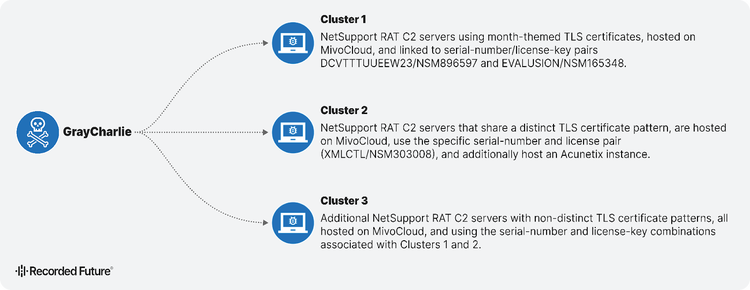
GrayCharlie, active since mid-2023 and overlapping with SmartApeSG, compromises WordPress sites to inject externally hosted JavaScript that redirects visitors to NetSupport RAT payloads delivered via fake browser update pages or ClickFix lures, often resulting in Stealc and SectopRAT follow-on deployments. Insikt Group mapped extensive infrastructure tied to MivoCloud and HZ Hosting Ltd, identified multiple NetSupport RAT C2 clusters and staging domains, and observed a likely supply‑chain compromise impacting numerous US law firm websites. #GrayCharlie #NetSupportRAT

Flare researchers observed threat actors rapidly sharing proof-of-concept exploits, offensive tools, and stolen administrator credentials for SmarterMail vulnerabilities CVE-2026-24423 and CVE-2026-23760, leading to automated mass exploitation and confirmed ransomware activity. Incidents including a SmarterTools breach and ties to the Warlock cluster highlight that email servers are identity-critical and require urgent patching, segmentation, and enhanced monitoring. #SmarterMail #CVE-2026-24423
Acronis TRU uncovered a targeted espionage campaign named CRESCENTHARVEST that uses Farsi-language protest lures to trick victims into opening malicious .LNK shortcuts and install a multi-module stealer/RAT. The implant chain relies on DLL sideloading via a signed Google binary, extracts browser app‑bound keys, logs keystrokes and exfiltrates data to a C2 in Riga. #CRESCENTHARVEST #AcronisTRU
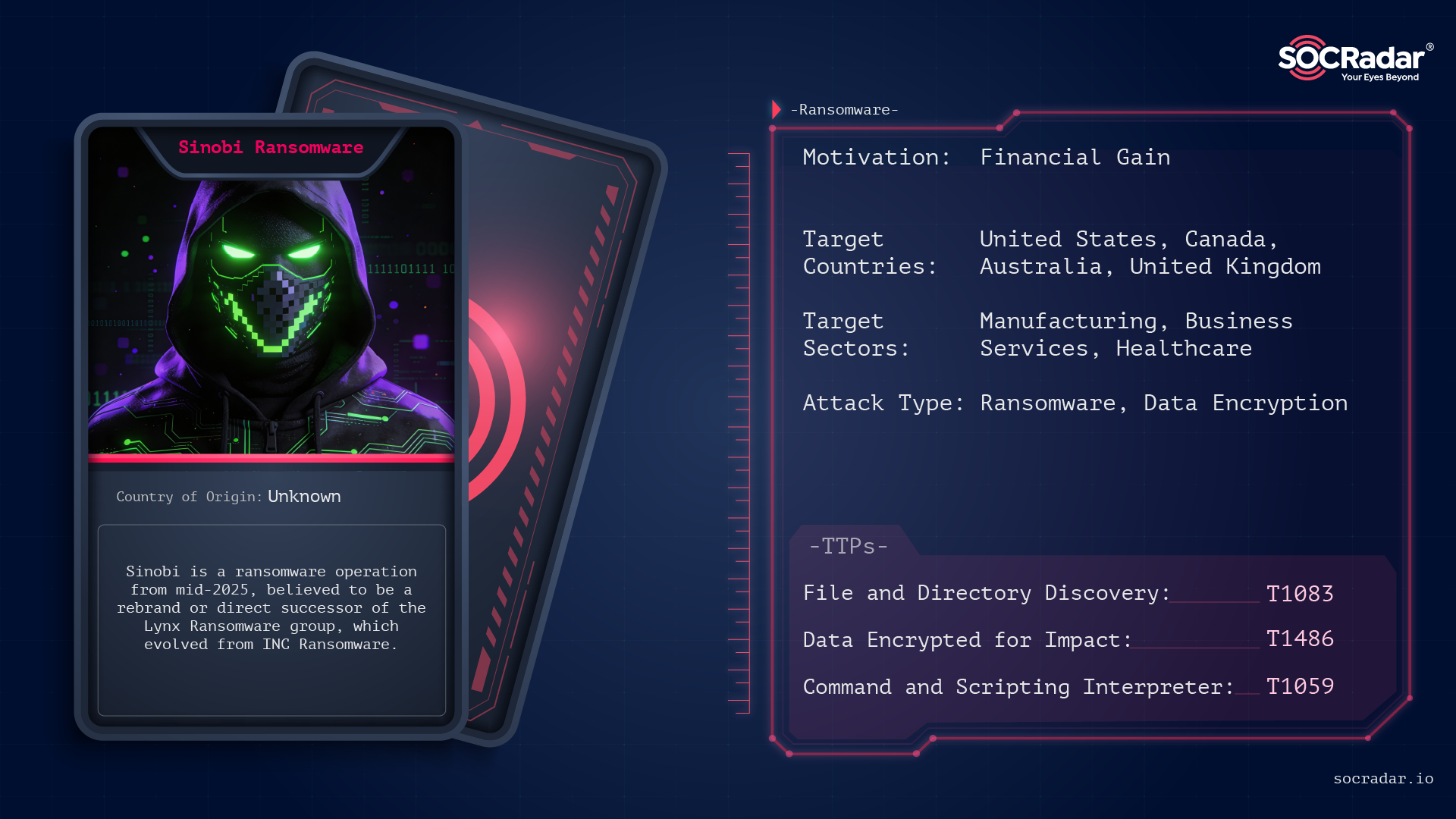
Sinobi is a Ransomware-as-a-Service operation that emerged in mid-2025 and appears to be a rebrand or successor to the Lynx and INC Ransom families based on significant code overlap. The group uses a closed affiliate model and double-extortion tactics—gaining access via compromised credentials and CVE exploits, exfiltrating data with Rclone, and encrypting files with Curve-25519/AES-128-CTR to demand payment. #Sinobi #Lynx

A suspected Chinese state-backed group, UNC6201, has been exploiting a hardcoded-credential zero-day (CVE-2026-22769) in Dell RecoverPoint for Virtual Machines since mid-2024 to gain unauthenticated access and root persistence. The intruders deployed a new C# backdoor called Grimbolt (replacing Brickstorm) and used stealthy Ghost NICs on VMware ESXi to move laterally; Dell urges immediate remediation. #UNC6201 #Grimbolt
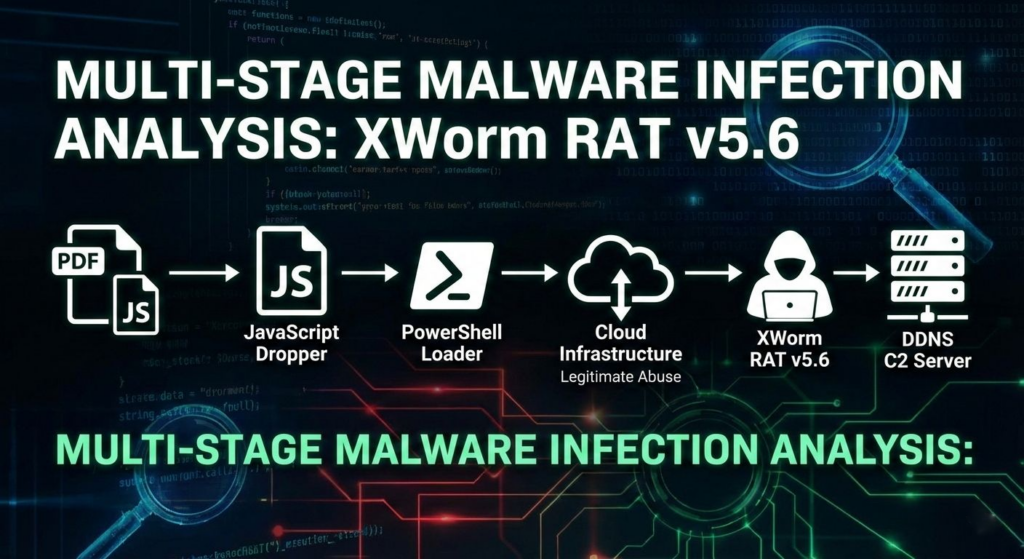
A multi-stage campaign targeting Brazilian users delivers XWorm via a deceptive “banking receipt” WSH dropper that uses obfuscated JavaScript, WMI-spawned PowerShell, Cloudinary-hosted steganography, and in-memory .NET loading to minimize early detection. The infection establishes persistence by registering a Scheduled Task via .NET APIs and injects the XWorm payload into CasPol.exe, enabling…
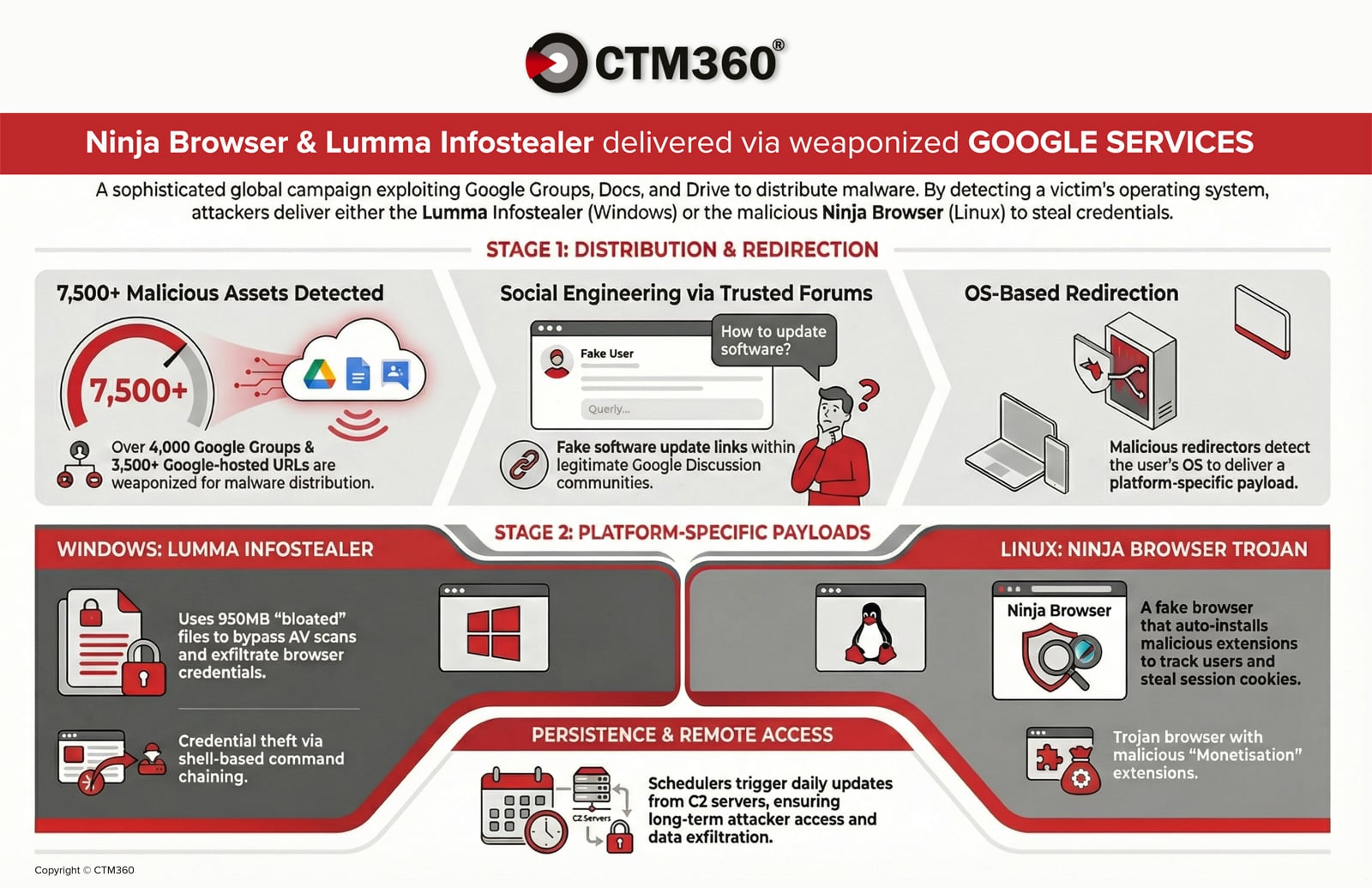
CTM360 reports an active global campaign abusing over 4,000 malicious Google Groups and 3,500 Google-hosted URLs to distribute credential‑stealing malware and establish persistent access on compromised devices. Windows users are targeted with an oversized, password‑protected archive delivering the Lumma infostealer, while Linux users are redirected to a trojanized Chromium “Ninja Browser” that silently installs malicious extensions and persistence mechanisms. #LummaStealer #NinjaBrowser

Cisco Talos reports that the threat actor UAT-9921 is using a new modular framework called VoidLink to conduct post-compromise C2 operations, internal and external scanning, and lateral movement against technology and financial services. VoidLink—written in Zig with C plugins and a Go backend, and possibly developed with LLM assistance—includes kernel-level rootkits,…

Google Threat Intelligence Group reports that state-sponsored, hacktivist, and criminal groups from China, Iran, North Korea, and Russia are conducting sustained, multi-vector campaigns against the defense industrial base, targeting drones, autonomous systems, supply chains, and personnel. These actors exploit messaging apps, device-linking features, hiring processes, edge devices, ORB networks, and diverse…

The defense industrial base faces sustained, multi-vector cyber threats from state-sponsored groups and hacktivists targeting personnel, supply chains, edge devices, and battlefield technologies such as UAS and secure messaging apps. Notable tactics include phishing and job-themed lures, exploitation of edge device zero-days, mobile malware, supply-chain compromises, and hack-and-leak or DDoS operations by pro-Russia and pro-Iran hacktivists. #UNC5221 #CANFAIL