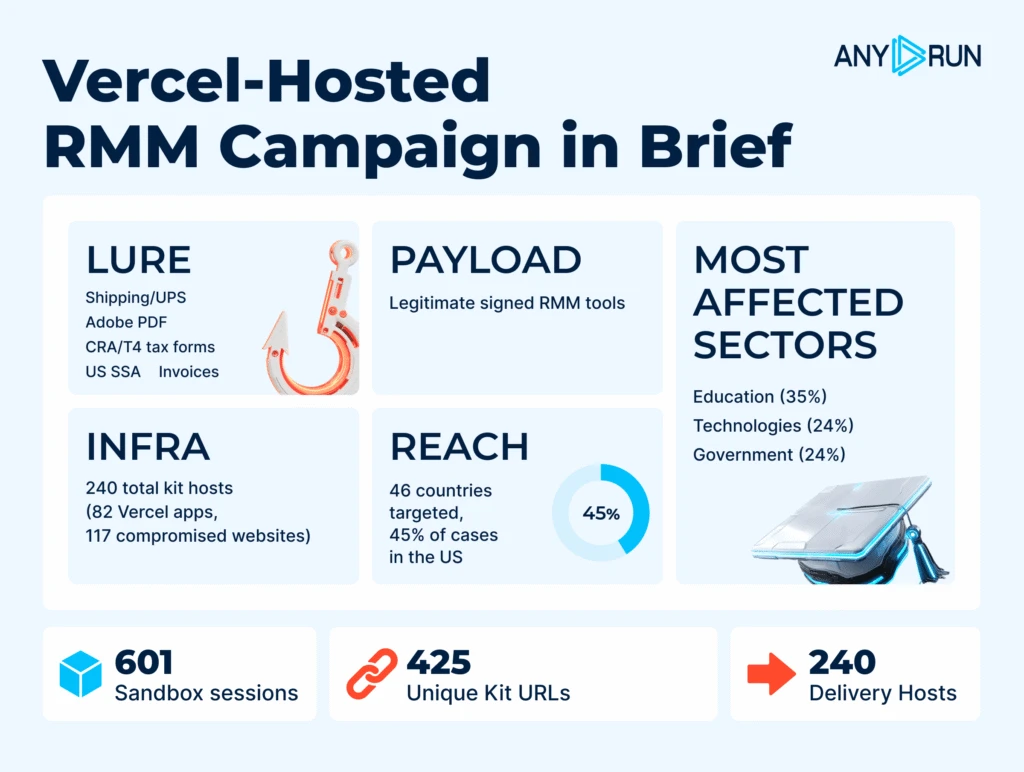
A phishing campaign that starts with fake CRA T4 tax documents is actually a 46-country operation that abuses legitimate remote management software to gain hands-on access to victim machines, with the United States accounting for 45% of observed activity. The kit reuses stable clues like fmtt, font1.woff2, and icons8-microsoft-word-94.png while rotating disposable infrastructure and lures such as SSA, Adobe PDF, invoices, VAT notices, and shipping notices. #CanadaRevenueAgency #GoToResolve #LogMeInRescue #ScreenConnect #ConnectWise #ITarian
Keypoints
- The campaign began as a fake Canada Revenue Agency T4 lure but is part of a broader remote-access operation spanning 46 countries.
- Observed activity is US-first overall, with the United States accounting for 45% of cases and North America representing 61% of family cases.
- The attackers use legitimate signed RMM software as the final payload, enabling hands-on-keyboard access while evading ordinary signature-based antivirus detection.
- Multiple document-themed lures are used across regions and sectors, including SSA, Adobe PDF, invoices, VAT notices, and shipping communications.
- The delivery chain uses disposable Vercel pages, password-protected ZIP archives, VBS scripts, and PowerShell to fetch and install the RMM agent.
- Infrastructure is highly ephemeral, with 94% of observed hosts appearing for only one day and new hosts generated continuously each month.
- Detection should focus on recurring kit patterns and unauthorized remote-access activity rather than on any single RMM product or domain.
MITRE Techniques
- [T1583.006 ] Acquire Infrastructure: Web Services – The operator used one-shot Vercel, Netlify, and GitHub Pages deployments to host lure pages and delivery infrastructure (’82 one-shot *.vercel[.]app deployments, one Netlify app, and *.github[.]io pages to host the lure kit’).
- [T1583.001 ] Acquire Infrastructure: Domains – The operator registered throwaway domains and dynamic-DNS names for kit delivery (‘registered 32 throwaway domains on cheap TLDs and used 7 dynamic-DNS names’).
- [T1584 ] Compromise Infrastructure – The operator used compromised legitimate websites to serve kit paths (‘used compromised legitimate websites … to serve the icons8-microsoft-word-94.png kit path’).
- [T1566.002 ] Phishing: Spearphishing Link – Victims were lured from phishing emails to disposable lure pages (‘used a CRA/T4 spear-phishing email to link victims to a *.vercel[.]app lure page’).
- [T1204.002 ] User Execution: Malicious File – The victim had to enter an access code, extract the archive, and run the script (‘use an on-page access code to induce the victim to extract and run the single VBS script’).
- [T1059.005 ] Command and Scripting Interpreter: Visual Basic – A VBS script launched the next stage of the attack (‘The VBS script used FileSystemObject to launch PowerShell’).
- [T1059.001 ] Command and Scripting Interpreter: PowerShell – PowerShell downloaded and installed the RMM payload (‘download the next stage’ and ‘downloads and installs the RMM MSI’).
- [T1027 ] Obfuscated/Encrypted Files: Password-Protected Archive – The kit used an encrypted ZIP to frustrate automated extraction (‘password-protected project/*.zip requiring the on-page access code’).
- [T1497 ] Virtualization/Sandbox Evasion – The campaign used browser/IP/geo fingerprinting, Telegram filtering, and sleep delays to evade analysis (‘browser/IP/geo fingerprinting … and sleep timing to evade analysis environments’).
- [T1105 ] Ingress Tool Transfer – PowerShell fetched the MSI installer from rotating staging infrastructure (‘download the RMM MSI from rotating S3 / R2 / GitHub / gofile / raw-IP staging’).
- [T1219 ] Remote Access Software – Legitimate RMM software was abused to provide hands-on remote control (‘used a signed RMM agent to establish hands-on-keyboard remote access’).
- [T1102 ] Web Service – Telegram was used to filter victims and conditionally deliver payloads (‘used api.telegram[.]org to filter victims and conditionally deliver the payload’).
Indicators of Compromise
- [Domains / Hosts ] Disposable lure pages and kit infrastructure – fillingconfirmation[.]vercel[.]app, sharedconfirmationslip[.]vercel[.]app, and 2026t4form17718[.]vercel[.]app
- [Domains / Hosts ] Malicious throwaway domains – quavix[.]vu, voretix[.]icu, and other cheap-TLD domains used for kit hosting
- [Domains / Hosts ] Dynamic DNS kit hosts – 54511[.]ddnsking[.]com, 67pon[.]swoop2[.]me, and other attacker-controlled DDNS subdomains
- [File / URL Path ] Stable kit paths on Vercel pages – */secure.html and */project/*.zip on *.vercel[.]app
- [File / URL Path ] Family-wide web asset pivot – */img/font1.woff2 and */img/icons8-microsoft-word-94.png
- [File / Hash ] Kit page assets – 41b731279b1778a9f578e4ed2589f46c4bef32793b292862cf96279a3ead1c41, 132d864bb199105d639edb115249302243eafdb0fc21efb86cc6b6c0d49866f0, and 51f0cc172ced2e90acbc01c2872c697644380e597076350a6b286c96ab7ccb42
- [File ] Captured RMM installer – LogMeInResolve_Unattended.msi
- [IP Address ] Durable origin and staging infrastructure – 46.62.197[.]232:7000 and other rotating cloud hosts
- [Cloud Storage / Web Services ] Payload staging locations – mayteslaadvisorhq[.]s3[.]us-east-2[.]amazonaws[.]com, openfodervbs4view[.]ams3[.]cdn[.]digitaloceanspaces[.]com
- [Domains / Sites ] Compromised legitimate sites serving kit paths – hiltonheadislanddeals[.]com, mybcdc[.]ca, and ypatellawoffice[.]ca
Read more: https://any.run/cybersecurity-blog/us-campaign-malware-analysis/